
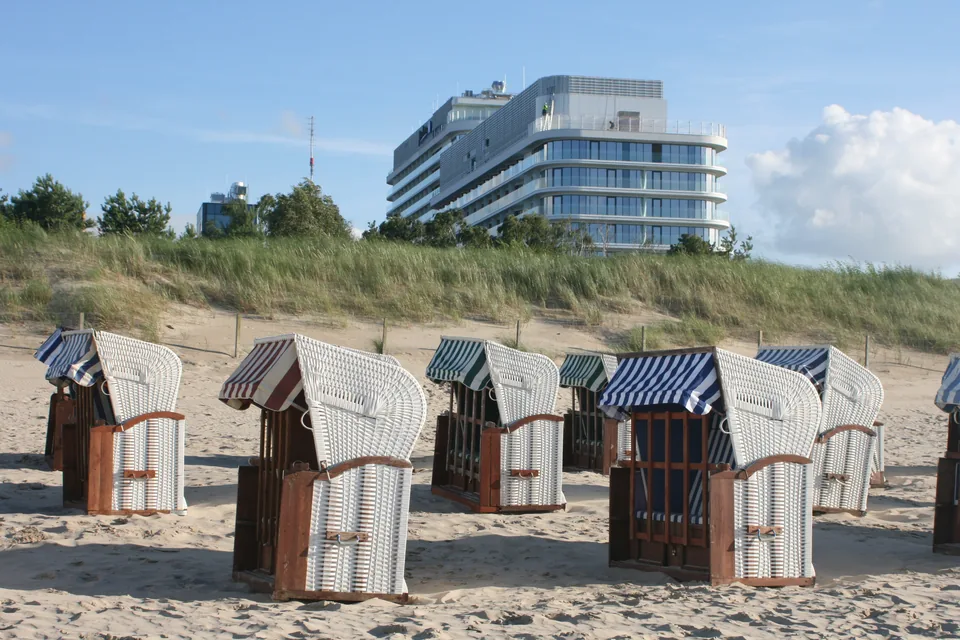
Between the promenade and the beach runs a belt of dunes and pine forest that most visitors simply cross on their way to the sea. It is worth slowing down – this is one of the most interesting natural corners of Świnoujście, and in autumn one of the loveliest places for a walk.
How the dunes in Świnoujście formed
The beach in Świnoujście is exceptionally wide because the sea has long been depositing sand here. Coastal currents carry it along the shore, and the wind blows it inland from the beach. Where the sand catches on plants, a dune begins to grow. Over time a new one forms in front of it, while the older one becomes more and more overgrown until it finally turns into forest. Walking from the water towards the promenade, you pass through several “generations” of coastline – from the youngest, shifting mounds to old pine woodland.
Naturalists describe three stages. The white dune lies closest to the sea: the sand is pale and loose, dotted with tufts of grass. The grey dune is more settled, covered with mosses, lichens and low plants that give it its greyish tone. Behind it begins the dune forest – mainly pine, mixed with other trees and shrubs.
This pattern is not purely the work of nature. Along much of the Polish coast, people have long planted dune grasses and pines to stop drifting sand and shelter buildings from the wind. Today the dunes are protected, and a good share of Świnoujście’s natural areas – from the coast to the Świna delta – lie within the Natura 2000 network.
What grows and lives on the dunes
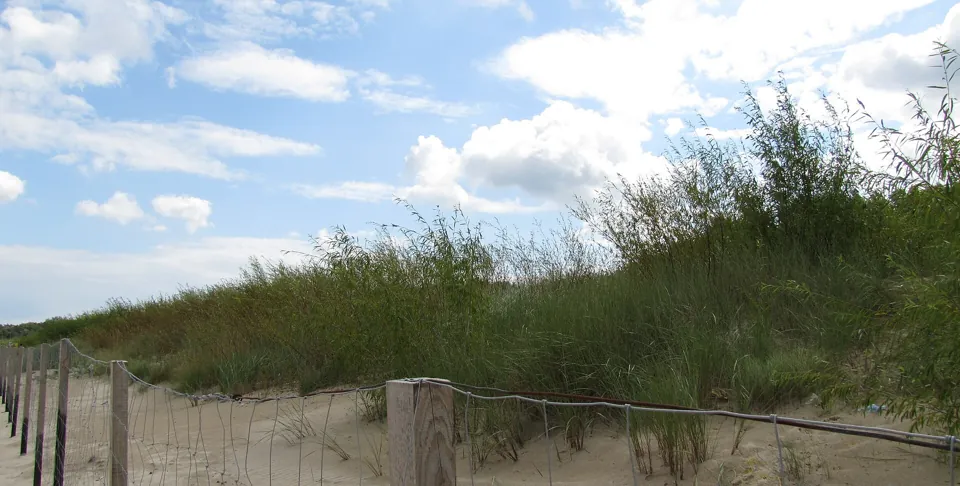
At first glance a dune is just sand and grass. Up close – ideally from a boardwalk or path – you can see how well the plants have adapted to wind, salt and drought.
- Dune grasses such as marram and lyme grass have long, branching roots that hold the sand like a net. They are the dune builders: the more sand the wind brings, the higher they grow.
- Mosses and lichens on the grey dune grow very slowly. A footprint can stay visible on them for a long time.
- Pines in the front row of the forest are often low and bent by the wind. The further from the sea, the taller and straighter they grow.
- Birds – in the forest you will hear tits, woodpeckers and other woodland species, while gulls circle over the beach. In autumn and winter, sea ducks and migrating birds are more often seen near the shore.
By the beach entrances you will also see the Japanese rose, with large pink flowers and red hips. It looks familiar, but it is an introduced species that crowds out native dune plants.
Why you should keep off the dunes
The rule is clear: do not walk on the dunes – use the marked crossings. The dunes in Świnoujście are protected, walking on them off the paths is forbidden and can result in a fine. More important, though, is why the ban exists.
- A dune is held together by plants. Once people tread a path, the grass roots break. The wind quickly blows away the exposed sand and a gap opens in the dune that grows with every storm.
- The dune protects the town. It is a natural sea wall that takes the force of the waves in a heavy storm and shields the forest, the promenade and the buildings behind.
- Plants and animals live on the dunes that cannot survive elsewhere. Every blanket spread on a slope means a few metres of damaged habitat.
Fences, ropes, brushwood bundles and netting on the slopes are not obstacles but protection. If you want to photograph the dunes, the best shots are from the boardwalks and the beach – from there you can see their shape and vegetation best. The same goes for dogs: a dog on a dune damages plants just as a person does.
A walk through the coastal forest
The forest strip behind the dunes is perfect for days when it is too windy or wet on the beach. The trees break the wind, the paths are flat and soft, and the air smells of resin and the sea at the same time. A few tips:
- Stay on the paths and forest roads – some are shared with cyclists, so watch out for bikes and ride considerately if you are on one yourself.
- Combine forest and beach – go one way through the forest and come back along the shore via a marked entrance. That gives you two completely different routes in one walk.
- West, towards the border – both the forest and the beach lead all the way to Ahlbeck. Carry an identity document.
- East, towards the Świna – around the harbour entrance, Stawa Młyny and the forts, the forest mingles with historic sites we have written about separately.
From spring to autumn there may be ticks in the forest – long trousers and a quick check after your walk are enough. Do not pick plants from the dunes, and never light a fire in the forest or on the beach.
An autumn walk along the shore
Autumn is the best time for long walks by the water. The beach empties, the sand along the waterline is firm and easy to walk on, and the low sun brings out the colours of the dunes and the forest. After each storm the shore looks a little different – the waves shift sand, expose roots or wash up seaweed and small treasures.
What to watch out for after a storm
- Undercut dune edges – strong waves can tear a vertical wall out of a dune. Do not walk right beneath it or climb on top: overhanging sand can collapse.
- The breakwater in high seas – when waves wash over the stones, enjoy the view from the beach instead.
- Early darkness – in autumn and winter, plan your return so that you are not walking through the forest after dark. A phone torch is not enough for a woodland path.
It is nicest when home is close by after a walk. Our apartments are on the promenade, a few minutes from the beach entrances and the forest paths. Have a look at our apartments or ask about dates for an autumn stay by the sea.