
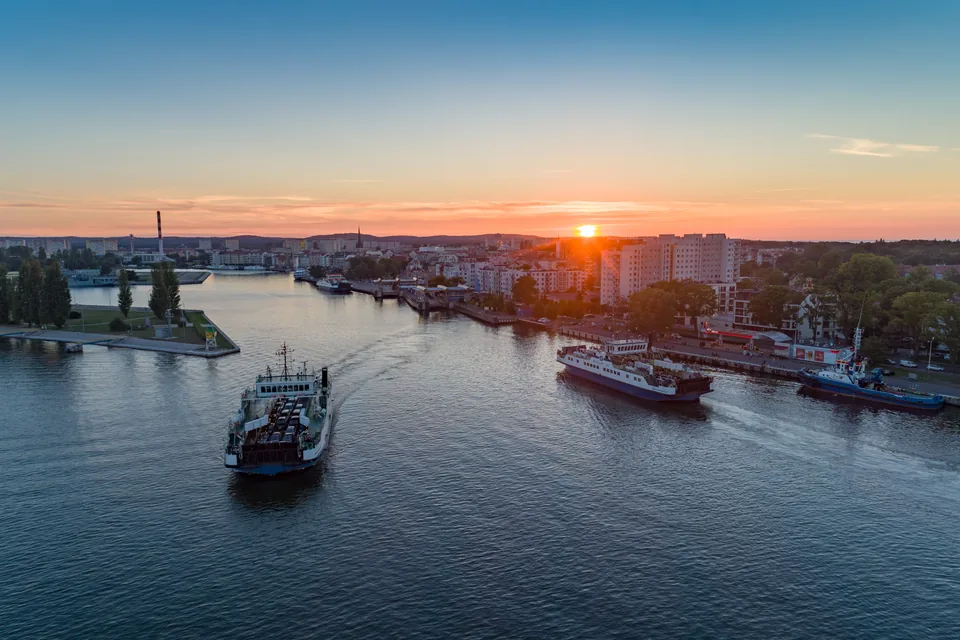
The white windmill at the end of the breakwater features in the Świnoujście logo and on most postcards from the town. We explain what Stawa Młyny really is, how to reach it and when the walk is at its best.
A windmill that never ground grain
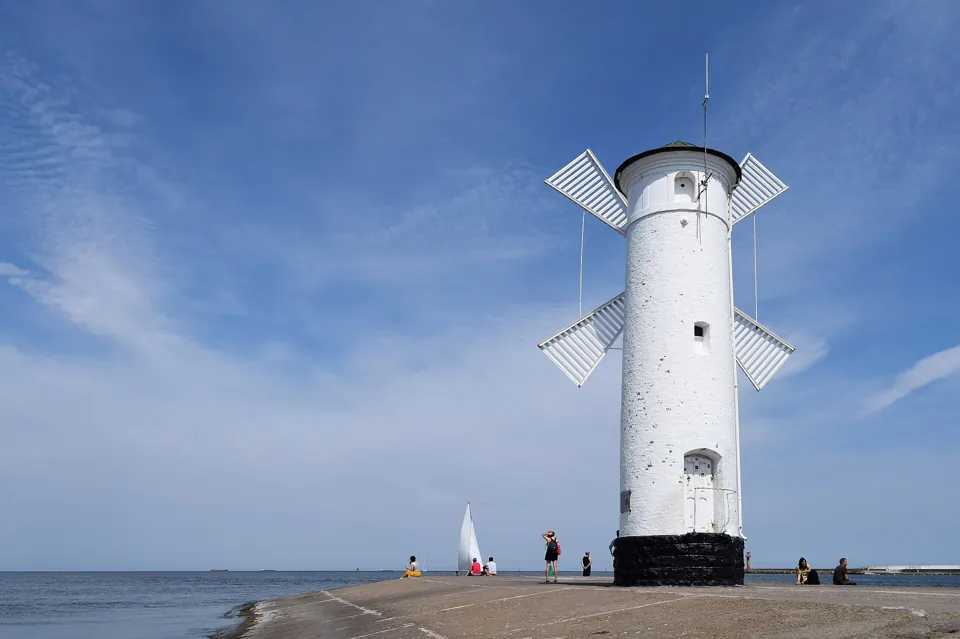
Stawa Młyny looks like a small windmill, but it was never a mill. It is a navigation beacon that shows ships the entrance to the port of Świnoujście. It stands at the very end of the western breakwater, where the River Świna flows into the Baltic. It is 10 metres tall, with a white body and a black roof.
Importantly, it is not just a relic of the past. The beacon is still an active navigation mark and shines at night for vessels approaching the port.
A short history
The beacon was built in 1873–1874, when the shipping channel into the port was being modernised. It was part of the system then used to guide ships in. In the early 20th century the tower was raised and fitted with steel sails and a light – a silhouette that makes the mark recognisable from afar.
Over time this practical structure became the town’s calling card. Its silhouette is part of the official Świnoujście logo.
How to get to Stawa Młyny
The beacon stands on the same side of the Świna as the seaside district, on the island of Usedom, so there is no need to take the ferry. There are two simple routes:
- Along the beach – go down to the beach and walk along the shore to the right (facing the sea), that is, eastwards. The windmill is visible from a long way off, so you cannot get lost. The firm sand by the water is the most comfortable to walk on.
- By the promenade and footpaths – follow the promenade east towards the mouth of the Świna, then take the paths through the belt of greenery to the foot of the breakwater. This is the better option in strong wind and with a pushchair.
From the central part of the promenade, an easy walk takes about 30–40 minutes each way. Allow an hour and a half to two hours for the whole outing with a stop for photos. You can also cycle to the area near the breakwater.
The last stretch: the breakwater
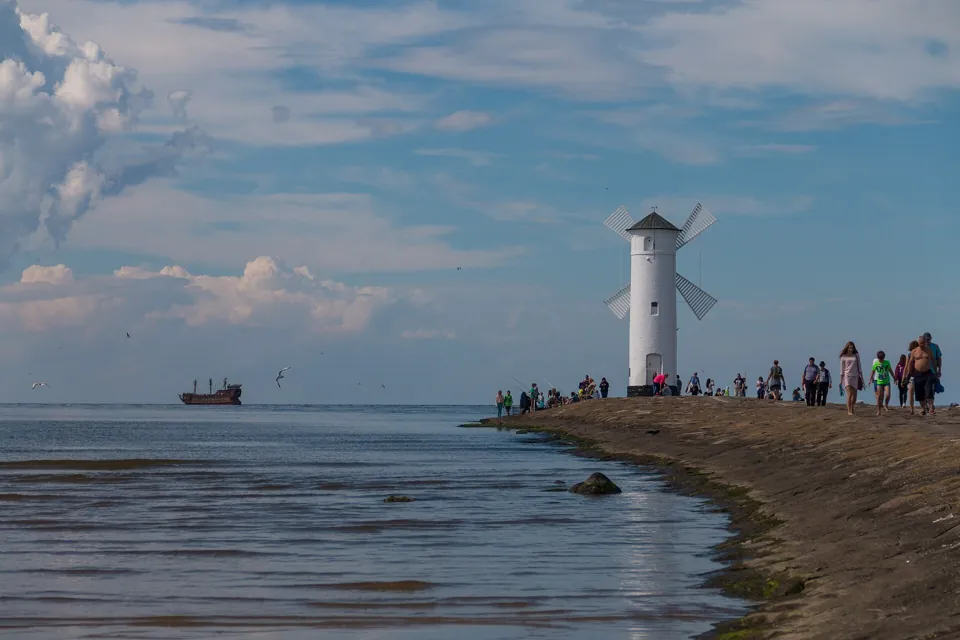
To reach the beacon itself you walk along the stone breakwater. It is a piece of harbour engineering, not a promenade: the surface is uneven, there are boulders on either side, and the stone gets slippery after rain or when the sea is up. Shoes with a good grip are a good idea. Hold small children by the hand, and with a pushchair it is better to stay on the beach – the windmill is clearly visible from there too.
In strong wind the waves break over the breakwater. Going onto it then is simply dangerous, and you should settle for the view from the shore. A storm watched from the beach is impressive as well.
Take something to drink and an extra layer. There are no facilities on the breakwater itself, and over open water it is often noticeably cooler than on the promenade – the nearest cafés are back in the seaside district.
When to go
- Early morning – the fewest people, soft light and quiet. The best time if you want a photo without a crowd in the frame.
- Before sunset – the most popular time. It gets busy in summer, but the light is at its loveliest. The torch on your phone is handy for the walk back at dusk.
- Out of season – in autumn and winter it is often almost deserted. Just dress more warmly, as there is no shelter from the wind on the breakwater.
What you can see from the breakwater
The breakwater is a good spot for watching the port traffic. Cargo ships and passenger ferries pass close by on their way into Świnoujście or out to sea. Across the river mouth, on the island of Wolin, you can see the eastern breakwater and the lighthouse – the tallest on the Baltic. In the other direction the wide beach stretches away towards the German resorts.
The walk to the beacon combines easily with a rest on the beach or a coffee on the promenade on the way back.
From our apartments by the promenade you can reach Stawa Młyny on foot, with no car and no ferry. You are warmly welcome – take a look at our apartments, and read about other places worth visiting on our page about Świnoujście.